
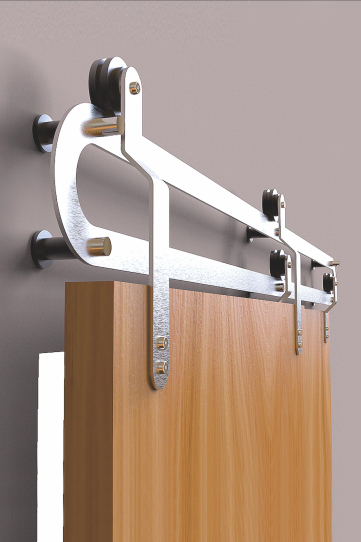
News
Contact UsBypass vs Bifold Closet Doors: Which System Provides Better Access
-
 author
- 17 August 2026
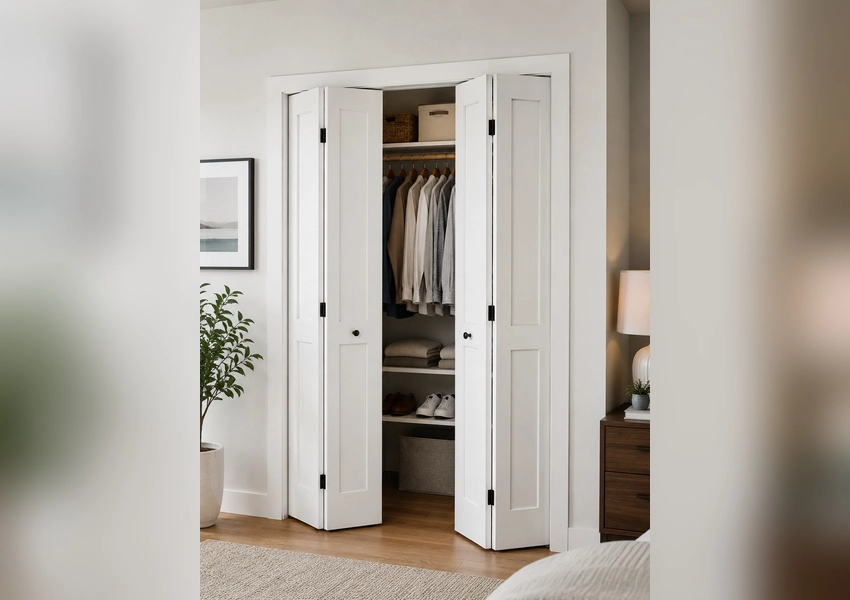
Closet doors look simple until a project reaches the mock-up room. Then the small annoyances start to show. One door blocks half the wardrobe. Another opens wide enough, but its folded panels crowd the bed, hallway, or drawer face. That is why the bypass vs bifold doors choice should be made from access first, not just from style.
Both systems belong in the space-saving closet doors conversation. They remove the full swing arc of a hinged door, and both can work in bedrooms, corridors, laundry corners, hotel wardrobes, and compact apartments. Still, they solve the access problem in different ways. A bypass system lets door panels slide past each other on parallel tracks. A bifold system folds panels to one or both sides, opening a much wider part of the closet at once.
Access Comes Down to How the Panels Move
For daily use, the best closet sliding door system is the one that lets people reach what they actually store. A wide coat closet, shared wardrobe, or pantry does not behave like a decorative passage door. Users may need the left side in the morning, the center section at night, and the right side for seasonal storage.
Bypass Doors Keep The Front Clear
Bypass doors slide within the opening width. The panels overlap each other, so there is no leaf swinging into the room and no folding stack projecting outward. This makes bypass door hardware practical where the floor in front of the closet is already busy, such as a narrow bedroom, a rental corridor, or a hotel wardrobe beside a luggage bench.
The tradeoff is partial access. With two panels, one side usually covers part of the other side when open. With three or four panels, access can improve, but the track depth and panel overlap still need careful measuring, especially when drawers or pull-out baskets sit inside.
Bifold Doors Open Wider But Need Stack Space
Bifold doors fold and stack near the jamb. That movement can expose most, and sometimes nearly all, of the closet width. For installers, this is useful when the owner wants a full visual view of shelves, hanging zones, and drawers without shifting panels back and forth.
The price of that wider opening is the folded stack. It takes room at the side or slightly in front of the closet. In a tight hallway, that stack may create a shoulder bump. In a bedroom, it may compete with a nightstand or cabinet door.
When Bypass Closet Doors Work Better
A bypass layout usually fits projects where the closet is wide, the room is narrow, and the user can accept seeing only part of the storage at one time. It keeps the walking path clean, which matters in apartments and compact hospitality rooms.
The bypassing sliding system is built around a dual-parallel track format. It includes top-hung or bottom-rolling bypass options, with configurations for two-door, three-door, or four-door layouts. The door panels slide past one another rather than folding out, so the system suits storage openings where swing clearance is the main problem.
The hardware details also matter for bulk orders. Bypass door hardware uses high-density 6063-T5 aluminum alloy track, supports up to 80 kg per door panel, and accommodates panels from 35 mm to 45 mm thick. Available finishes include matte black, polished chrome, brushed nickel, and bronze. Bypass doors are strongest when the closet contents are divided by zone. If every user needs full-width access at once, bypass becomes less convenient.
When Bifold Closet Doors Give Better Access
A bifold doors are better when the biggest concern is opening width. Instead of hiding one panel behind another, the panels fold together and park at the side. This makes shelves, drawers, and hanging rails easier to scan in one look. For children’s rooms, laundry closets, walk-in closet entries, and renovation projects where full access is valued, bifold systems can feel more natural.
Bifold door sliding system is designed around a top-hung or bottom-rolling folding mechanism. It includes 6063-T5 high-strength aluminum alloy, matte black, charcoal grey, brushed silver, and champagne gold finish options, as well as double-or triple-glazed tempered safety glass for projects that use glass panels. The folding styles listed include 330, 431, 550, 633, and 770, giving buyers several panel combinations to match different openings.
A higher access benefit is obtained by introducing more joints in movement. Therefore, while designing a bypass door, more attention has to be given to hinges, pivot points, rollers, guides, etc. and also to their alignment. Thus, bifold door hardware, which can support up to 100 kg per leaf, only gives the benefit if door weight, choice of tracks, fixing to the wall, and site tolerance are all checked together.

The Access Test For Bifold Layouts
A simple mock-up test helps: open the door fully, then pull out the widest drawer or basket. If the folded stack blocks that movement, the access advantage weakens.
Hardware Checks Buyers Should Not Skip
Closet doors are handled many times a day. The panel motion may look fine in a showroom, but repeated use will expose weak rollers, thin tracks, poor stops, and loose guides. For project buyers, the better system is the one that stays aligned after installation.
For bypass hardware, confirm track depth, panel overlap, door thickness, top-hung or bottom-rolling structure, guide position, and whether the left, right, or center sections can be reached without frustration. A quiet glide also depends on roller material and how the track is fixed.
For bifold hardware, confirm panel width, folding direction, hinge strength, pivot position, stack depth, and whether the folded leaves can sit clear of drawers, handles, and nearby furniture. The system may provide better access, but only if the folded panels park in a place the room can spare.
Metek positions its wider sliding door system around barn door, invisible door, pocket door, bifold, bypassing, and biparting categories. That matters because closet projects often need more than one answer. A hotel may use bypass doors for narrow guest wardrobes, bifold doors for larger service closets, and solid wooden doors for higher-privacy interiors. One supplier with related systems can help keep finish, packaging, and installation logic closer across the project.
Project Buying Advice: Match Access With Service Risk
Before choosing between bypass vs bifold doors, separate the closet into three questions. What must be reachable at the same time? How much space exists in front of and beside the opening? Who will maintain the door after handover? A closet sliding door system should answer those questions before the sample is approved.
For rental units and hospitality rooms, bypass may reduce service calls because there is less folding action and less projection into the room. It suits simple wardrobes where partial access is acceptable. For family homes, laundry rooms, and closets with drawers, bifold doors may reduce daily irritation because users can see and reach more of the opening.
Metek has supplied barn door hardware, sliding doors, metal-frame glass doors, frameless glass doors, and related home improvement products since 2011. Its manufacturing base covers about 12,000 square meters, with 92 production machines, 3 testing machines, and more than 80 employees. It has CE, FSC, ANSI-BHMA, EN 13561, EN 12600, Proposition 65, TPCH, and selected third-party testing. For B2B buyers, these details are useful when samples need to become repeatable bulk orders rather than one attractive prototype.
Packaging is another quiet part of access quality. Door panels, rails, rollers, handles, stops, floor guides, and small accessories have to arrive together, protected, and easy to identify on site. Metek has hardware packed individually, door and hardware packed together, retail display boxes, reinforced cartons, foam protection, and wooden cases for glass or door panels. Good packaging does not change the door opening, but it can reduce missing parts, site delays, and replacement claims.
For custom closet projects, Metek can support discussion around size, finish, structure, installation guidance, inspection, delivery terms, spare accessories, and replacement parts. The cleaner decision is not simply bypass or bifocal. It is the system that gives enough access, fits the room, and can be repeated across the whole order without surprises. If you are also wondering more, our article answers that.
FAQ
Q1: Which system gives better closet access, bypass or bifold?
A1: Bifold usually gives wider access because the panels fold aside. Bypass is better when the room needs a clear front area and partial access is acceptable.
Q2: Are bypass doors good space–saving closet doors?
A2: Yes. Bypass doors save floor space because panels slide on parallel tracks inside the opening. The main limit is that one panel can cover part of the closet.
Q3: What should buyers confirm before choosing bifold door hardware?
A3: Check panel weight, folding direction, hinge and roller quality, stack depth, wall fixing, finish options, packaging, and whether the open panels clear drawers or nearby furniture.





Our Products
Our Products

our testimonials
What They Say About Us

"We trust Metek, have always had a very good relationship with each of you folks;
Metek is reliable, not only as business partner, but also friends.
You can tackle issues; you can go on and move on.
And that’s what’s we did—together with all Metek!"

"Metek is 10 years old, and we have been working with Metek for more than 8 years.
We still welcome progressing and achieve more than what we did last year.
And it is big achievement, which was done at Metek last ten years.
In the next decade, we will keep going and develop the Australian market together."

"To all Metek members
We now work six years together,we still grow together with Metek, with one of our best suppliers in China.
Why are you one of the best?
It’s because you help us to create our market; you help us to create new products; and you help us to get the right quality; you help us to wonder our issues.
You know, you are all very good educators; you understand our language; you understand us as customer.
And I think that makes the partnership show you are together.
And I hope for the next years, we can still work together, and move on together into your future creative, beautiful products."