
News
Contact UsWhy Barn Doors Do Not Block Sound and How Buyers Can Improve Privacy
-
 author
- 01 September 2026

A barn door is typically used to close off a visual opening into a room, and not to soundproof a bedroom, study, hotel room, treatment room, etc. In fact, many buyers expect a door to reduce voices, music, etc., and hallway noise, and a familiar-looking sliding panel is what they expect to find. Note that while a barn door looks like a solid panel, in reality there are many gaps around the door, on both sides and at the top and bottom, and this can allow sound to easily escape or enter a room. And even with a heavy roller kit, this type of door does not make a soundproof barn door, as sound can easily travel through any gaps and follow the edges of the door, and this can be through a very narrow gap. In fact, even a very thin door can allow sound to travel from one room to another through the gaps around the edges of the door, and this is often more so if the door has a lightweight panel, a thin wall, and hard surfaces for sound to reflect off.
Why Barn Doors Leak More Sound Than Buyers Expect
The Outside-Mounted Track Leaves A Perimeter Gap
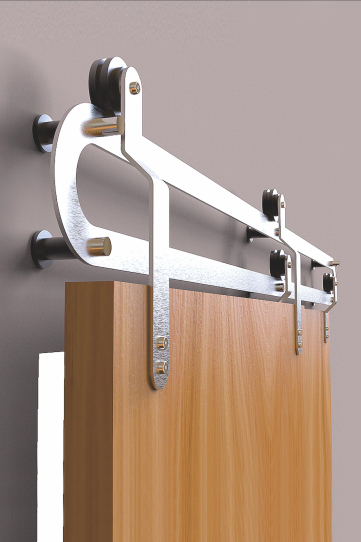
A standard barn door requires clearance around the wall for the panel to slide in and out. The clearance around the door creates a continuous line around the opening as opposed to the compression seal found on hinged doors. The lower edge of a barn door typically has a guide attached to the door and the wall. The purpose of this guide is to keep the door in line so it does not wander from side to side.
However, this guide does not form an acoustic seal. The motion of sliding a door also limits how well the door can fit against the wall. If a panel were to rub against the wall, it would not open and close smoothly. That practical installation requirement explains why barn door privacy is usually weaker than hinged-door privacy, even when both doors use similar materials. A barn door sliding system should therefore be specified as a space-saving opening method first, then checked for any added privacy details.
A Light Panel And Hard Room Surfaces Make The Problem Worse
A hollow or thin panel has less mass to resist airborne sound. Glass, MDF, solid wood, and composite panels behave differently, but none of them can compensate for an open perimeter. Tile, concrete, and bare wood floors may also reflect sound back toward the gap, making a room feel louder than the door specification suggests.
What Barn Door Sound Insulation Can Realistically Improve
While better privacy can be achieved with a barn door, this door can only cover a limited number of direct sightlines. Also, some sound transfer can be softened by the door, but as a rule of thumb, it is difficult to make such a door perform like a certified acoustic door unless it can be changed as a whole, including the opening, the panels, and the way of sealing.
Use A Heavier, More Stable Door Panel
For a sound-sensitive project, start with the slab rather than the decorative finish. A dense solid-wood, engineered-wood, or other substantial panel generally gives a better base than a thin hollow panel. The panel still needs to stay within the hardware load and thickness range, and its weight should be checked together with the hanger, guide, stopper, and fixing method.
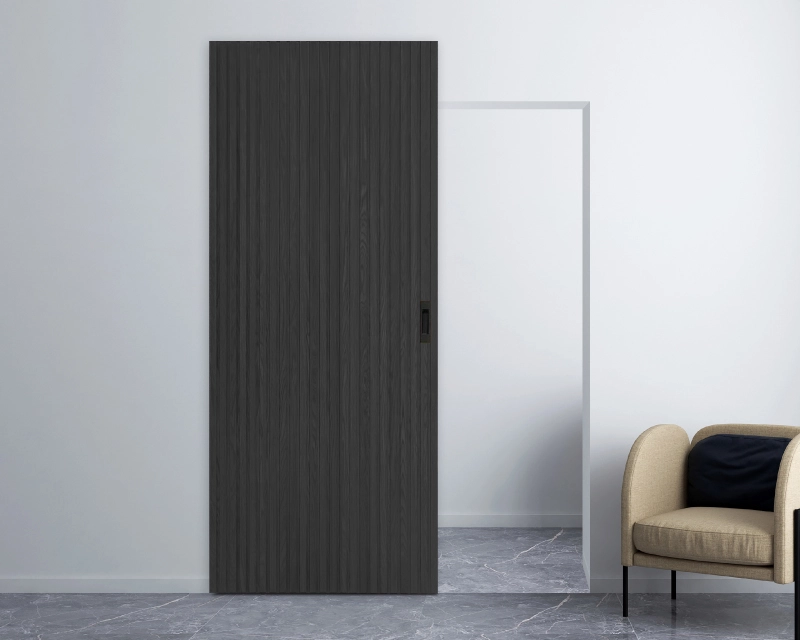
The invisible sliding barn door supports customizable WPC and engineered-wood substrates. The concealed track removes exposed upper and bottom rails from view and leaves the floor clear, which can help with cleaning and circulation. Those features improve the visual and practical side of privacy, but they do not turn a sliding panel into a sealed soundproof barn door.

Close The Gaps At The Top, Sides, And Bottom
A barn door gap seal can be useful when the project allows a controlled sealing detail. Options may include a side brush or compression seal, a top seal, an overlapping edge, and a bottom sweep or drop seal. Each one must be tested against the actual panel movement. A seal that drags, catches on trim, or prevents the panel from reaching the stop will create complaints of its own.
The bottom edge deserves special attention. A floor guide prevents lateral swing, while a drop seal or sweep addresses the air path under the panel. They are different jobs. Buyers should not accept a floor guide as proof of acoustic performance.
When An Acoustic Sliding Door Is The Better Direction
Some rooms need more than appearance and basic separation. If the project involves confidential meetings, bedrooms beside living areas, a study used for calls, or hospitality rooms beside a corridor, the door should be selected as part of a sound-control assembly. Wall construction, seals, frame details, and the panel all matter.
Ask For The Performance Boundary, Not A Vague Promise
The phrase “acoustic sliding door” can describe several different products. It may refer to a door with an acoustic panel, a sliding fitting designed for quiet movement, or a tested door assembly with a stated rating. Those are not interchangeable. Ask what was tested, in which configuration, and whether the result applies to the full opening or only to the panel.
Metek sets a clear boundary: the space-saving sliding door is not a soundproof or room-closing door. It has a solid pine frame, HDF, MDF slats, and a powder-coated sliding fitting with a maximum load of 100 kg and at least 100,000 opening and closing cycles under DIN EN 1527. Quiet movement and sound isolation are separate buying questions.
Consider Concealed Or Pocket Construction For Higher Privacy
If the room needs a cleaner seal, a pocket door or a purpose-built acoustic door may be a better fit than an exposed barn door. A pocket system stores the panel inside the wall, which removes the visible wall-side gap. It also adds framing, coordination, and service-access requirements, so it should be planned before the wall is closed.
A concealed barn door can help where the project wants a calmer appearance and less visible hardware. Metek’s invisible sliding barn door uses concealed hardware, a flush pull, no floor track, and a sliding layout suited to bedrooms, studies, and en-suite rooms. The privacy result still depends on the panel and perimeter detailing, but the system gives the designer more control over the finished opening.

Buyer Checks Before Ordering A Privacy-Focused System
For distributors, contractors, and project buyers, the most useful specification is a short list that can be checked against the sample and the production order. The following points reduce the risk of receiving attractive hardware that cannot meet the room’s actual privacy needs:
- Confirm the target: visual privacy, reduced conversation transfer, quieter movement, or tested acoustic performance.
- Record the panel material, size, thickness, total weight, edge detail, and finish before choosing the track.
- Measure the gap at the top, sides, and bottom after installation, then decide whether a barn door gap seal is practical.
- Check the substrate, header board, bracket spacing, wall clearance, floor guide, anti-jump parts, and stopper adjustment.
- Ask for cycle testing, load limits, installation drawings, spare seals, replacement rollers, and the exact configuration used for any test result. For exposed hardware packages, also check whether a stainless steel barn door hardware kitfits the panel weight, finish, and wall condition.
- Review packaging. Rails, glass, panels, and small fittings should arrive protected and clearly separated so missing or damaged parts do not delay site work.
Metek has supplied barn doors, barn door hardware, wooden doors, metal-frame glass doors, frameless glass doors, and acoustic panels since 2011. Its sliding door system gives buyers several ways to plan the opening before committing to a privacy claim. The 12,000 m² manufacturing space, 92 production machines, and 3 testing machines, as well as over 80 employees at our facilities, make us an ideal supplier for buyers with large-scale product development plans and repeat orders for establishing their respective product lines.
OEM and ODM support can also matter when privacy requirements differ by market. A distributor may need a denser panel, a different finish, custom packaging, or a hardware set prepared for a specific opening. Continue reading our another guide.
FAQ
Q1: Can a barn door be made completely soundproof?
A1: A typical outside-mounted barn door is not completely soundproof because the sliding clearance leaves air paths around the panel. Better results require a heavier panel, controlled seals, and a suitable wall and opening design.
Q2: Does a barn door gap seal solve the whole privacy problem?
A2: No. A seal can reduce air leakage at one edge, but the panel, wall, top and side gaps, bottom detail, and installation accuracy still affect barn door sound insulation.
Q3: What should a buyer request from a supplier?
A3: Request the panel and hardware limits, test configuration, cycle data, seal options, installation drawings, packaging plan, spare parts, and any customization available for the target room.





Our Products
Our Products

our testimonials
What They Say About Us

"We trust Metek, have always had a very good relationship with each of you folks;
Metek is reliable, not only as business partner, but also friends.
You can tackle issues; you can go on and move on.
And that’s what’s we did—together with all Metek!"

"Metek is 10 years old, and we have been working with Metek for more than 8 years.
We still welcome progressing and achieve more than what we did last year.
And it is big achievement, which was done at Metek last ten years.
In the next decade, we will keep going and develop the Australian market together."

"To all Metek members
We now work six years together,we still grow together with Metek, with one of our best suppliers in China.
Why are you one of the best?
It’s because you help us to create our market; you help us to create new products; and you help us to get the right quality; you help us to wonder our issues.
You know, you are all very good educators; you understand our language; you understand us as customer.
And I think that makes the partnership show you are together.
And I hope for the next years, we can still work together, and move on together into your future creative, beautiful products."