
News
Contact UsWhy Your Metal Door Frames Look “Wrong” On Site (And How to Fix It)
-
 author
- 20 July 2026

A metal door frame can look right in a drawing, then look slightly wrong on site. This happens more often than people expect. The casing line is not straight enough. The black finish looks a bit different near the corner. A screw head appears where the wall was supposed to stay clean. Nothing is broken, yet the doorway already feels less refined. For hotels, offices, apartments, and retail interiors, this kind of detail is hard to ignore. One uneven frame may not seem serious. Twenty uneven frames along the same corridor are a different story. That is why metal door frame design should be checked before production starts, not only when installers begin fixing problems on site.
Why Metal Door Frame Casing Details Matter
Metal frames are often chosen because they give stable support and a cleaner edge than many timber frames. They work well with glass panels, hinged doors, sliding systems, and interior partition openings. Metal also reacts less to humidity than wood, so it is useful in many indoor projects. The difficult part is that metal does not hide mistakes well. A wood casing can sometimes be sanded, filled, trimmed, or repainted after installation. A powder-coated steel or aluminum frame is different. Once the finish is done, the edge, joint, and wall gap become part of the final look.
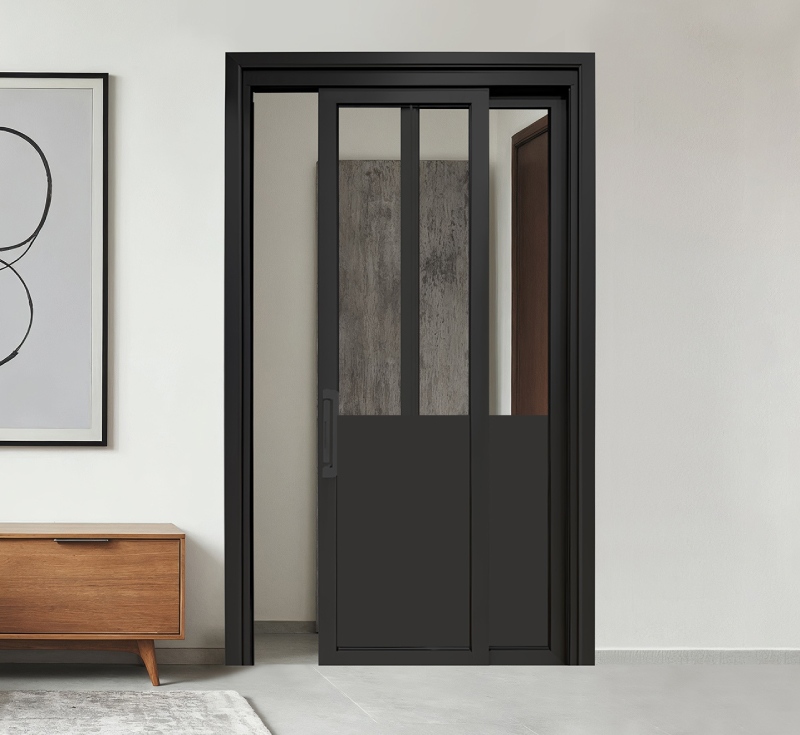
This is especially clear on black metal-framed glass doors. The dark frame stands out against the wall. If the reveal is uneven, people notice it quickly. The slim-frame black powder-coated glass-hinged door depends on its slim profile and clean glass area. If the casing line is crooked or the coating tone shifts, that simple visual effect becomes weaker.
Common Casing Flaws Buyers Should Notice Early
Misaligned Frame Edges and Uneven Joints
Misalignment often starts before the frame reaches the site. The wall opening may not be square. The plaster may be thicker on one side. The floor may drop slightly. Sometimes the shop drawing is fine, but the actual opening is not. After fixing, these differences appear as uneven gaps or crooked reveal lines. In a single room, the issue may feel small. In a hotel corridor or office project, the same small mistake repeats and becomes obvious.
CNC machining and modular prefabrication help keep frame parts consistent before shipment. Still, factory precision cannot correct a poor site measurement. If a project requires a visible tolerance such as ±1 mm per meter length, that detail should be written into the drawing, discussed with the installer, and checked before final fixing. A sample room is useful for repeated projects. It lets the team look at casing width, corner joints, reveal gaps, wall finish, and hardware position before the same detail is used across many openings.
Inconsistent Surface Finish or Color Tone
Finish problems show quickly on metal frames. Matte black may show uneven gloss. Brushed stainless steel may show different brushing directions. Powder coating may peel or discolor if the surface was not prepared well.
Surface preparation is not a minor factory step. Oil, dust, oxidation, grinding marks, uneven pretreatment, and unstable curing can all affect the result. For powder-coated carbon steel or anodized aluminum frames, finish samples should be approved before mass production. If the project uses strong corridor lighting or warm hotel lighting, the sample should be checked under similar light. Black metal-framed glass doors need extra care here. Black looks sharp only when the tone is stable. One glossier section, one coating mark, or one rough corner can make the whole opening look less controlled.
Visible Screws, Welds, and Hardware Mismatch
A frame can be strong and still look unfinished. This often happens when fixing details are decided too late. Screws appear on a surface that was meant to stay clean. Weld marks catch the light. Hinges, handles, or rollers do not match the frame finish. Concealed fastening can help, but it has to match the wall condition and load requirement. It is not about hiding every technical part. It is about making the visible parts look planned.
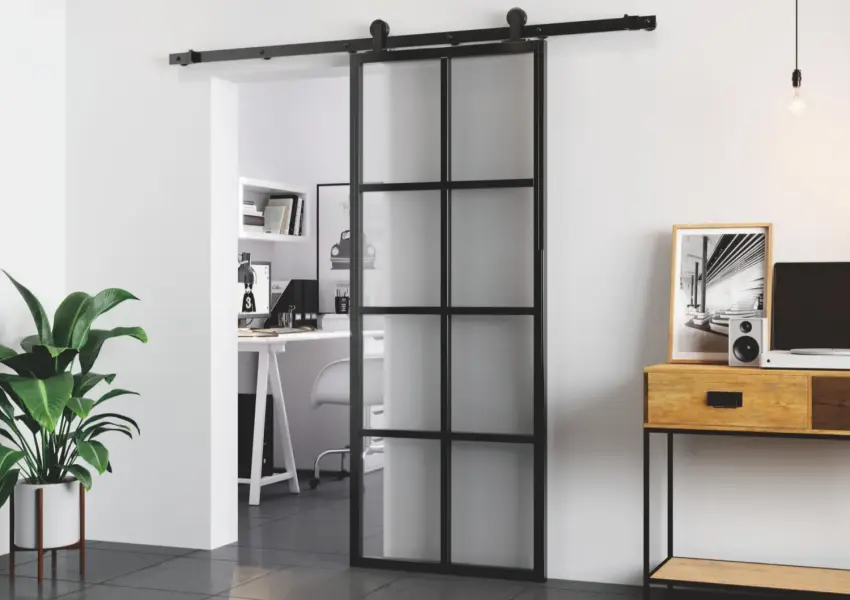
The iron frame tempered glass sliding barn door shows why this matters. The glass texture and iron frame already create the main visual character. If the rollers, handles, screws, or brackets fight with the finish, the door starts to look busy.
Fabrication Should Follow the Real Opening

Good fabrication starts with plain project information: wall thickness, opening width, frame depth, door or glass weight, casing style, finish requirement, and hardware position. If these points are unclear, the factory may produce a frame that is accurate by itself but awkward on-site. Laser cutting can create cleaner edges. CNC processing keeps repeated parts more stable. Modular prefabricated components reduce on-site adjustments. These methods help in hotel renovations and commercial fit-outs, especially when many openings use the same casing detail.
Surface finishing needs the same discipline. Powder coating and anodizing protect the frame, but they also determine how the frame looks. Coating thickness, curing temperature, surface cleaning, and batch control all matter. Dark finishes usually need more care because small defects are easier to see.
Installation Decides the Final Impression
Many casing flaws appear during installation. The frame has to be plumb, level, and square. Concrete, drywall, and masonry do not take fasteners in the same way. Shims and fixing methods should match the wall condition instead of simply filling whatever gap appears.
Before final fixing, installers should step back and check the reveal line from more than one angle. Corners, frame-to-wall gaps, hinge-side alignment, threshold level, and hardware position all deserve one more look. Once the surrounding wall finish is completed, small corrections become harder and usually cost more. For large projects, the first finished room should not be rushed. It is the test room. It shows whether coating tone, casing width, screw position, hardware color, and wall finishing are right before the same detail is repeated across the building.
Choosing Metal, Finish, and Frame Profile
Within the three metals available, there are three very different products. Steel is a very strong material, and at Slim Frame Doors, we have found that it is ideal for making very slim industrial-style doors. Aluminum is a lighter material and is ideal for interior use when handling large numbers of doors. Stainless steel is strong, corrosion-resistant, and has a very polished finish, ideal for high-end commercial interiors and luxury interior use. The finish of the metal is also very important and should match the interior and the planned level of maintenance. A matte black finish looks great in a modern interior but does show up dirt and scratches very easily.
Maintenance Is Part of the Design
Metal frames are usually easy to maintain, but the wrong cleaner can damage the finish. Non-abrasive cleaners are safer for coated surfaces. Harsh chemicals may weaken powder coating or cause discoloration. Hinges, corners, seals, and tracks should be checked from time to time, especially in hotels, offices, and retail spaces. Discoloration on black metal-framed glass doors may come from poor surface preparation, unstable powder-coating conditions, unsuitable cleaning chemicals, or long exposure to sunlight and moisture. Before ordering, buyers should confirm coating type, curing process, finish sample, and cleaning instructions.
Working with Metek on Metal Door Frame Projects
Hangzhou Metek Co., Ltd. has been supplying barn doors and barn door hardware, metal-frame glass doors, wooden wall planks, acoustic panels, shower rooms, resin tables, etc. since 2011. Our factory is located in Taizhou, Zhejiang Province, covering an area of 12,000 square meters. We have 92 sets of production machines and 3 sets of testing machines, with more than 80 employees. For the metal door frame and casing projects, we can offer product selection, frame profile discussion, finish planning, hardware matching, packaging, OEM/ODM service, etc. And we can communicate with our customers on these topics. Metek has several product lines relevant to the above projects, such as CE-marked, FSC-certified, ANSI-BHMA-graded, EN 13561, EN 12600-standard, etc., depending on the type of products. Continue reading our another guide.
FAQ
Q1: What causes discoloration on black metal frame glass doors over time?
A1: Discoloration of a black powder-coated metal-framed glass door over time may have occurred for reasons such as bad surface preparation, bad powder coating application, wrong chemicals used for cleaning, and aging caused by excessive exposure to sunlight and moisture. Please confirm the coating type, the curing process, the request for a finish sample, and the instructions for cleaning and maintenance before you place an order.
Q2: How can misalignment be avoided during installation?
A2: Measuring up accurately in the first place is the best way to avoid any problems with fit. With CNC-machined components, the doors and frames can be cut to exacting dimensions and arrive at the site almost ready to be put up. All the components for the frame can also be prefabricated, which can save a lot of time and hassle during installation. It is also a good idea to double-check the following during installation: Is the wall flat? Is the frame level? Is the frame plumb? Are the reveal gaps all correct before fixing them?
Q3: Are customized sizes available for commercial projects?
A3: Yes. Many systems are available in custom sizes to suit individual projects. It is always worth checking that your chosen system is able to meet all of your requirements prior to the commencement of production. Details to check include load-bearing requirements, wall thicknesses, weight of glass/door, etc., plus packaging for site and installation requirements.





Our Products
Our Products

our testimonials
What They Say About Us

"We trust Metek, have always had a very good relationship with each of you folks;
Metek is reliable, not only as business partner, but also friends.
You can tackle issues; you can go on and move on.
And that’s what’s we did—together with all Metek!"

"Metek is 10 years old, and we have been working with Metek for more than 8 years.
We still welcome progressing and achieve more than what we did last year.
And it is big achievement, which was done at Metek last ten years.
In the next decade, we will keep going and develop the Australian market together."

"To all Metek members
We now work six years together,we still grow together with Metek, with one of our best suppliers in China.
Why are you one of the best?
It’s because you help us to create our market; you help us to create new products; and you help us to get the right quality; you help us to wonder our issues.
You know, you are all very good educators; you understand our language; you understand us as customer.
And I think that makes the partnership show you are together.
And I hope for the next years, we can still work together, and move on together into your future creative, beautiful products."