
News
Contact UsWhat Makes a Glass Interior Door Practical for Daily Use
-
 author
- 06 July 2026
Glass interior doors often look better in photos than many solid doors do. The room seems brighter, the frame looks neat, and the whole opening feels lighter. That is why they are easy to choose too quickly. But once the door opens into a real project, the decision becomes more practical. A bathroom door cannot be judged the same way as a showroom partition. A meeting room needs different glass from a kitchen. A hotel suite may need privacy, quiet movement, and easy cleaning all at once. If the glass, frame, and hardware are not matched to the room, the finished door may look good but feel wrong in daily use.
Start From the Room First
A glass door should begin with one simple question: What is the room actually used for? A retail entrance may need clear visibility. A private office may need daylight but not full exposure. A bathroom needs privacy. A hotel room needs a calm look and hardware that will not feel rough after repeated use.
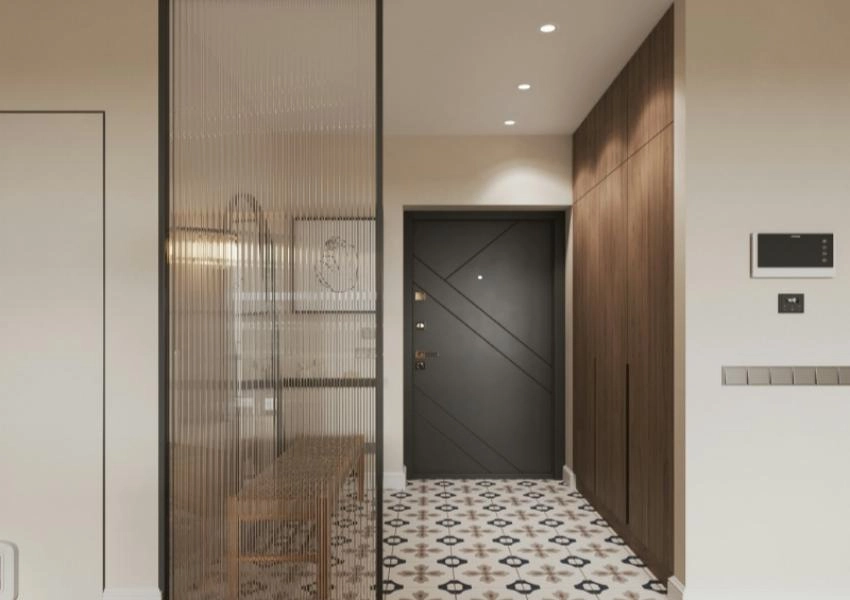
The Fluted Reeded Glass High Transparency Partition works well in spaces where a full solid wall would feel too heavy. A product photo does not always show how exposed a room will feel after installation.
Light, Privacy, and Sound Need to Be Checked Together
Glass brings light into a room. This is one of the many benefits provided by glass, and in small homes, office corridors, hotel interiors, and narrow commercial properties in particular, it is a real benefit. Sound control is another detail that should not be left until the end. Thick tempered glass, suitable seals, and careful installation may help reduce sound transmission. Even so, the full system matters. Gaps around the panel, frame structure, wall condition, hinge position, and track alignment all affect the result. If these details are checked only after installation, changes are usually more difficult and more expensive.
Choosing the Right Glass Type
Tempered glass is commonly used for interior glass doors because it has higher impact resistance than ordinary float glass. When damaged, it breaks into smaller pieces. For homes, offices, hotels, retail stores, and other interiors, this makes it a practical choice for daily use.
Laminated glass is chosen for a different reason. Its interlayer helps hold the glass together if it breaks. Depending on the structure, it may also support acoustic comfort or UV control. This can matter in office partitions, hotel suites, and meeting rooms where a quieter feeling is part of the project goal.
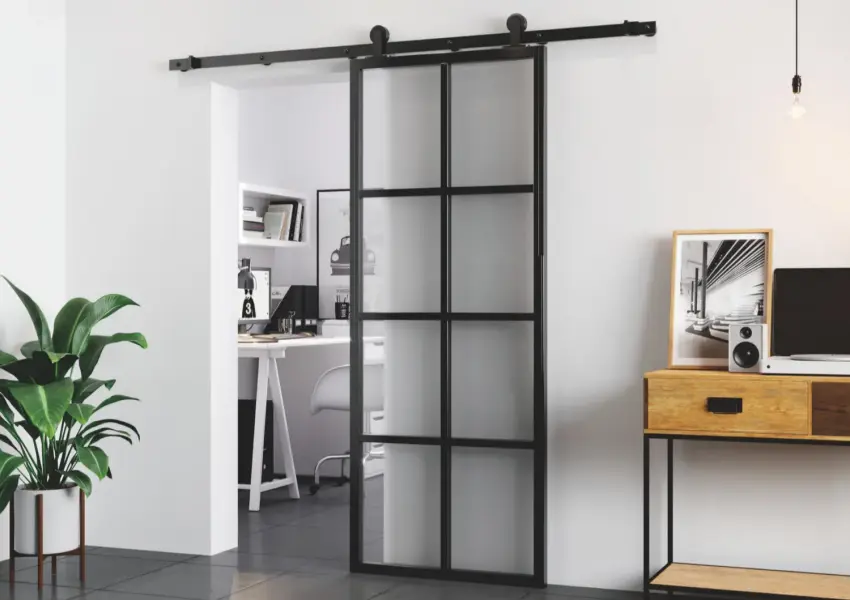
Textured glass gives designers another way to manage light and privacy. Acid-etched, sandblasted, reeded, and ripple surfaces all change the way light passes through the panel. Metek’s iron-frame glass sliding barn door uses 5 mm ultra-clear tempered glass with silver ripple texture. The panel stays bright, but the ripple surface makes the view softer than plain, clear glass.
Frames, Hinges, and Tracks Affect the Final Feel
The frame is not only a border around the glass. It changes the look of the door, the support level, and the installation tolerance. A thicker frame gives the door stronger visual lines. A slim frame leaves more glass visible. A frameless door looks cleaner, but it also leaves less room to hide small alignment mistakes.
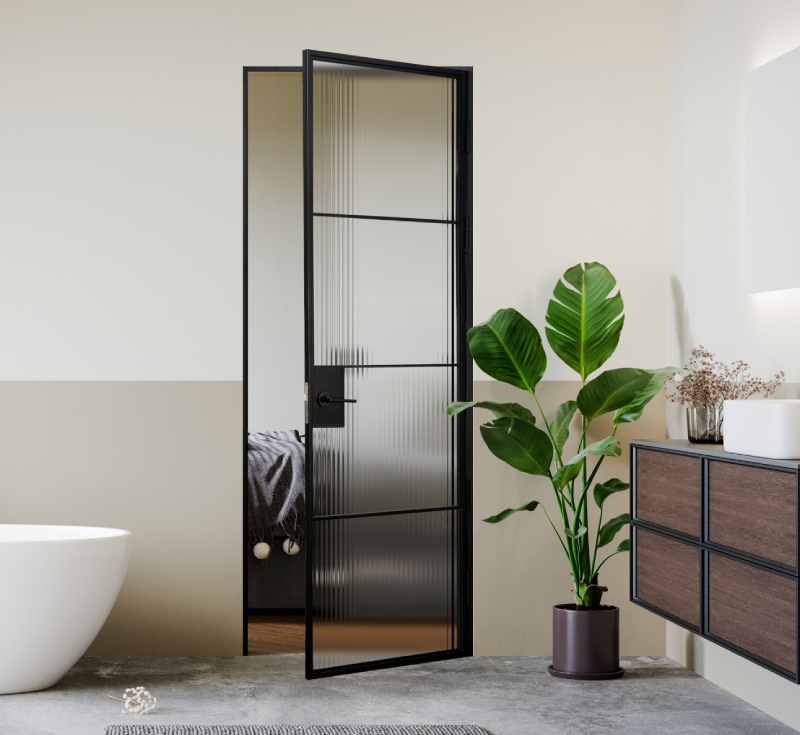
Metek’s slim-frame glass hinged door uses an ultra-slim carbon steel frame with 5 mm tempered glass panels. The black powder-coated finish gives the door a sharper outline, so it fits modern, industrial, and commercial interiors well.
A frameless glass door creates another effect. It is made from high-clarity, heavy-duty tempered glass. It can make two rooms feel more connected. At the same time, the installation has to be handled carefully because there is less framing to cover small errors.
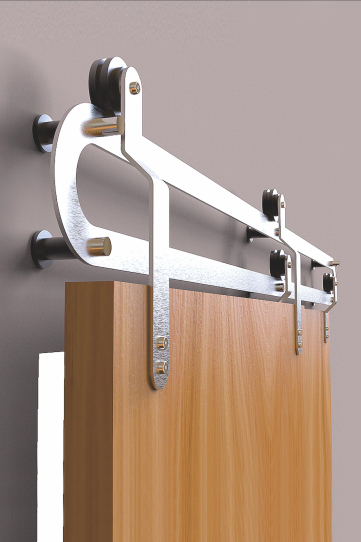
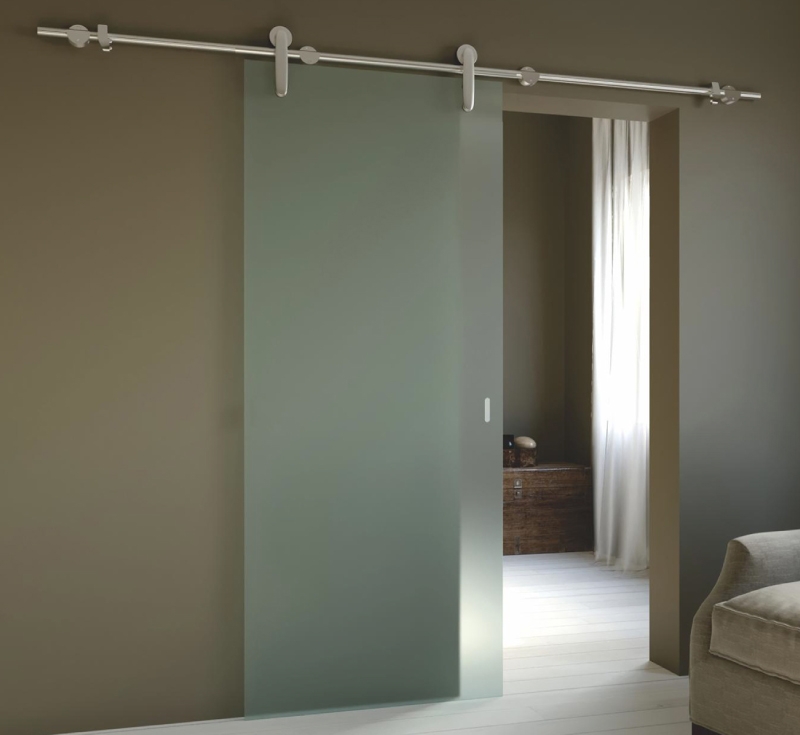
Hardware should be discussed before production. Hinges, pivot fittings, sliding tracks, stoppers, and soft-close parts all affect daily use. A sliding system removes the swing arc of a hinged door, which helps in compact spaces. But the panel weight, track rating, fixing points, wall condition, and maintenance access still need to match the project.
Safety and Standards Are Not One Single Check
 Glass door safety depends on several details working together. The glass type matters, but so do edge treatment, frame support, hardware capacity, wall condition, and installation quality. Applicable Metek product lines are produced or tested according to relevant standards such as CE, FSC, ANSI-BHMA, EN 13561, EN 12600, and Proposition 65, where required by the product type and project market. These standards do not all apply to the same part of the door. A glass impact standard may relate to the panel. A hardware standard may relate to hinges or tracks. A material sourcing standard may relate to another component.
For large glass panels or high-use commercial doors, project details should be confirmed before fabrication. Glass thickness, panel size, frame structure, hinge capacity, track rating, fixing method, packaging, and wall condition all need attention. These checks may sound ordinary, but they often prevent costly site adjustments.
Where Glass Interior Doors Usually Make Sense
Clear glass is usually best for open-plan living spaces and rooms that are frequently used by more than one person. Reeded, frosted, or patterned glass is more suitable for private spaces where there is a need for privacy. In offices, glass doors are typically used for meeting rooms, managers’ offices, and partition systems. As with all door types, they can initially look great but then become a major issue if they start to shake, creak, or bang when closing or do not provide sufficient privacy. The frequency of opening and the quality of hardware used are key. In hospitality, retail, and restaurants, the door needs to look good and last; each door can require different types of glass and different door frame construction. It is crucial to review drawings and door opening dimensions before production and not wait until installation.
Cleaning and Later Maintenance
Glass doors are not difficult to clean, but the surface type matters. Non-abrasive cleaners are safer for frosted, coated, or textured glass. Rough tools may damage micro-textures or coatings.
Tracks, hinges, joints, and seals also need occasional checking. Dust can affect sliding movement. Hinges may need adjustment in busy areas. Good installation reduces many later complaints. Correct alignment, suitable sealing, and proper fixing points help the door stay smoother and safer during daily use.
Working With Metek
Hangzhou Metek Co., Ltd. supplies barn doors, barn door hardware, metal frame glass doors, wooden wall planks, acoustic panels, shower rooms, resin tables, and related products. Metek is able to select the proper product, customize it, match frames, and select hardware and packaging for glass interior door projects, as well as provide technical information. Products offered by Metek for interior use include partitions as well as hinged, sliding barn doors and frameless as well as metal-frame doors made of glass for residential as well as commercial interior use. If you would like to know more, please contact us. If you would like to learn more, please read this article.
FAQ
Q1: What distinguishes tempered from laminated glass in interior applications?
A1: Tempered glass is processed for higher impact resistance and breaks into smaller pieces when damaged. It is often used for daily interior safety. Laminated glass uses an interlayer that helps hold the glass together if it breaks.
Q2: How do sliding mechanisms enhance space efficiency compared with hinged doors?
A2: A hinged door needs a swing arc. A sliding system removes that arc, so furniture, fixtures, and walking paths can be planned more freely near the opening. This is useful in apartments, offices, hotel rooms, bathrooms, and compact commercial interiors.
Q3: Are customized dimensions available for large-scale installations?
A3: Yes. Dimensions can be customized according to glass type, frame structure, hardware capacity, and project drawings. For large panels, the load, safety requirements, installation conditions, and packaging method should be reviewed before fabrication begins.





Our Products
Our Products

our testimonials
What They Say About Us

"We trust Metek, have always had a very good relationship with each of you folks;
Metek is reliable, not only as business partner, but also friends.
You can tackle issues; you can go on and move on.
And that’s what’s we did—together with all Metek!"

"Metek is 10 years old, and we have been working with Metek for more than 8 years.
We still welcome progressing and achieve more than what we did last year.
And it is big achievement, which was done at Metek last ten years.
In the next decade, we will keep going and develop the Australian market together."

"To all Metek members
We now work six years together,we still grow together with Metek, with one of our best suppliers in China.
Why are you one of the best?
It’s because you help us to create our market; you help us to create new products; and you help us to get the right quality; you help us to wonder our issues.
You know, you are all very good educators; you understand our language; you understand us as customer.
And I think that makes the partnership show you are together.
And I hope for the next years, we can still work together, and move on together into your future creative, beautiful products."